Is Laparoscopic Surgery Safe? Risks and Benefits Explained
If your doctor has advised laparoscopic surgery, you may have many questions. Is it safe? Will it hurt? How long will recovery take? Can it affect fertility? These are common concerns. Laparoscopic surgery is now used for many gynaecological problems. It is also called keyhole surgery or minimally invasive surgery.
The good news is that laparoscopy is generally safe. It also has some benefits over open surgery. But, like any surgery, it has some risks. Let us understand the procedure in simple terms.
What Is Laparoscopic Surgery?
Laparoscopic surgery uses small cuts instead of one large cut. The doctor makes a small opening in the abdomen. A thin tube with a camera is then placed through this opening. This tube is called a laparoscope.
The camera sends images to a screen. This helps the surgeon see the organs inside the abdomen and pelvis. The doctor may make a few more small cuts if treatment is needed. Small surgical tools are placed through these cuts. Laparoscopy is often used in gynaecology. It can help doctors find and treat certain problems at the same time.
Why Is Laparoscopy Done?
A doctor may suggest laparoscopy to find the cause of a problem. It can also be used to treat the problem.
It may be recommended for conditions such as:
Endometriosis
Ovarian cysts
Fibroids
Pelvic pain
Ectopic pregnancy
Pelvic adhesions
Some problems with the fallopian tubes
Some causes of infertility
In some cases, the doctor can find the problem and treat it during the same surgery.
Is Laparoscopic Surgery Safe?
Yes, laparoscopic surgery is generally safe. However, no surgery is completely free from risk. Your doctor will first check your health. They will also look at your medical history. Previous abdominal surgery may also be important.
The type of problem matters too. Some cases are simple. Others may need more complex surgery. The skill and experience of the surgeon also matter. This is why it is important to choose trained Laproscopic Surgeons for your treatment. Your doctor should explain the benefits and risks before surgery. This helps you make an informed choice.
What Are the Benefits of Laparoscopy?
Laparoscopy has several benefits.
1. Smaller cuts
The cuts are much smaller than those used in open surgery. This can mean smaller scars and less damage to nearby tissue.
2. Less pain
Many patients have less pain after laparoscopic surgery than after open surgery. You may still have some pain or discomfort. This is usually temporary.
3. Faster recovery
Small cuts can help you recover sooner. The exact recovery time depends on the type of surgery. Your doctor will tell you when you can return to work and normal activities.
4. Shorter hospital stay
Some laparoscopic procedures are done as day-care surgeries. This means you may be able to go home on the same day. More complex procedures may need a longer stay.
5. Better view of the pelvic organs
The camera gives the surgeon a clear view of the pelvic area. This can help find problems that may not be easy to see with scans alone.
6. Diagnosis and treatment together
In some cases, the doctor can find a problem and treat it during the same surgery. For example, endometriosis, cysts or adhesions may be treated during laparoscopy when suitable.
What Are the Risks of Laparoscopic Surgery?
Laparoscopy is safe for most patients. But some risks are possible.
These may include:
Bleeding
Infection
Pain around the cuts
Reaction to anaesthesia
Injury to nearby organs
Injury to blood vessels
Formation of scar tissue
Serious problems are uncommon. However, your risk may be higher if you have certain health problems or have had earlier abdominal surgery. In some cases, the doctor may need to change from laparoscopic surgery to open surgery. This may be done if it is safer for the patient.
What Happens After Laparoscopy?
You may feel tired after the surgery. This is common after anaesthesia. You may also have mild pain around the cuts. Some women have bloating or shoulder pain for a short time. This can happen because of the gas used during the procedure. Your doctor will give you instructions for recovery.
You may be asked to:
Get enough rest
Keep the cuts clean and dry
Take your medicines as advised
Avoid heavy exercise for some time
Attend your follow-up visit
Do not rush back to your normal routine. Give your body time to heal.
When Should You Call Your Doctor?
Some discomfort is normal after surgery. But certain symptoms need medical attention.
Call your doctor if you have:
Severe or increasing pain
Fever
Heavy bleeding
Redness or swelling around the cut
Pus or unusual discharge
Trouble passing urine
Fainting or severe weakness
These signs should not be ignored. Early medical care can help prevent problems from becoming serious.
How Can You Make Laparoscopic Surgery Safer?
The first step is to have a proper consultation. Tell your doctor about your medical history. Also share details about any medicines or allergies. Your doctor may suggest blood tests or scans before surgery. These tests help the medical team plan your treatment.
You should also ask questions before the procedure. Ask why you need surgery. Ask about other treatment options. Ask about recovery and possible risks.
Choosing an experienced gynaecologist and surgical team is also important. If you are looking for the Best Gynecologists in Delhi, make sure you choose a doctor who understands your condition and explains your treatment clearly.
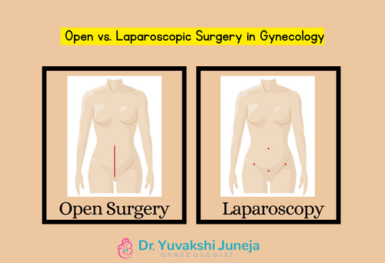
Also Read: Choosing the Right Path: Open vs. Laparoscopic Surgery in Gynecology
Laparoscopy and Women's Health
Laparoscopy can be useful in many areas of women's health. It may help treat endometriosis, ovarian cysts, fibroids, and some fertility-related problems. For some women, treating a problem such as endometriosis or pelvic adhesions may also help improve the chances of natural pregnancy. But this depends on the cause of infertility and the patient's overall health.
This is why laparoscopy should not be seen as the right treatment for everyone. Your doctor needs to decide if it is suitable for you.
Final Thoughts
Laparoscopic surgery is a minimally invasive procedure that uses small cuts and a camera to diagnose or treat problems inside the abdomen. It may mean less pain, smaller scars, and faster recovery, but risks vary depending on your health and the type of surgery.
Dr Yuvakshi Juneja provides gynaecological care and laparoscopic procedures. A consultation can help determine whether laparoscopy is right for you and what to expect during recovery.
Disclaimer: This article is intended for general informational and educational purposes only. It does not replace professional medical advice, diagnosis, or treatment. Please consult a qualified and registered medical practitioner for advice based on your individual health needs.
FAQs
1. Is laparoscopic surgery safe?
Yes. Laparoscopic surgery is generally safe when it is suitable for the patient and performed by a trained surgical team. However, every surgery has some risks.
2. Is laparoscopy painful?
You will usually be under anaesthesia during the surgery. So, you should not feel pain during the procedure. Some pain or discomfort may occur after surgery.
3. How long does it take to recover from laparoscopy?
Recovery depends on the type of surgery. Some patients return to light activities within a few days. More complex surgery may need more time.
4. Does laparoscopy leave scars?
Yes, but the scars are usually small. They may also become less visible as the cuts heal.
5. Can laparoscopy help with infertility?
In some cases, yes. It can help find and treat problems such as endometriosis, adhesions and some tubal problems. Your doctor will decide if it is useful for you.